The CORE alpine wardrobe: by Patagonia

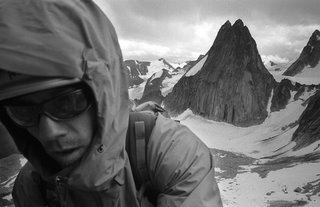
R1 Hoody. When you find yourself soaked with sweat after sprinting up an easy section, don't worry, this piece will dry faster than any other. N face of Mt. Temple in Summer.
-----------------------------------------------
I have been working (as an ACMG guide) and engaging in a multitude of harsh alpine conditions over the past 17 years. A few of those years included upwards of 200 days a year in the alpine. -40C days ice climbing in the Canadian Rockies (stupid, I know). Wet, open bivy's in winter conditions. Snowfield sprints, IE: wet, followed by 2 hour belays. Multiple days in an icy single wall tent.
The most important thing I have learned in terms of a clothing system for alpine climbing is that synthetics are a must. Down sleeping bags or insulated jackets are useless when wet and also more vulnerable when you get a hole in the shell material. Also, merino wool takes too long to dry. Both Wool and Down are acceptable when you know for certain you will be able to stay dry, working at a moderate level, and sleeping in your home. If you are getting committed or striving for an objective it is necessary to go with synthetics.
I have been working with Patagonia for a year now (sleazy sales guy, I digress) and feel I have discovered the best clothing system yet. It is not always easy to know what is the best clothing system when looking online or even trying on clothes in a store.
Here is my recipe for summer and winter alpine climbing:
Top:
- Capilene 1 t-shirt: Silky smooth, fast drying and layers nice.
- R1 hoody: offers lightweight insulation that is super fast to dry, super light, and crazy breathable. It is longer in the torso so it stays tucked into your pants when ice climbing. The best insulation for moisture management.
- Houdini Jacket: A paper thin, nylon jacket with a functional hood. Very windproof and often all you need for a day of alpine climbing in winter or summer. Also kicks ass for mountain biking and nordic skiing.
- M10 jacket. This is the most breathable waterproof jacket Patagonia has ever made....and it stretches! It is super light weight and minimalistic. I find that 95% of the time my rain jacket is stowed away in my pack which means I need it lightweight and packable.
The above items are often what I use in all 4 seasons when heading out into the bigger peaks. +20C to -20C. I recently used these exact items while rock climbing on Yamnuska, the North Face of Temple, and all last winter while ice climbing.
What changes with the seasons is what I bring as an insulated jacket/belay jacket.
Summer= Nano puff pullover or hoody (60g of primaloft 1)
Winter= Micro Puff Hoody or DAS Parka (100g and 170g of primaloft 1)
Bottom:
- Capilene 1 or 2 in the summer. Capilene 3 or 4 in the winter.
- Rock Guide pants in the summer or if minimal snow. Alpine Guide pant in the winter.
- M10 pant. Optional. I usually don't take waterproof pants in the winter but often take them on committing climbs in the summer.
The above clothing system works for rock, ice, alpine, expedition climbing as well as ski touring.
If you want to save a few dollars you could go with the Rainshadow pants and jacket instead of the M10. It would be slightly heavier, not quite as breathable, and not 3 layer but still totally acceptable in terms of weight and functionality.
As a representative for Patagonia, as a guide, and as a climber I get a lot of questions about 'what I recommend' from store employees, clients, and my climbing partners. Well, this is what I really think. Of course there are many other options but these are the CORE Patagonia items that every climber would see benefit from having in their quiver.
Links:
Capilene: http://www.patagonia.com/us/search/capilene-baselayer/?k=6x&te=capilene-baselayer
R1 Hoody: http://www.patagonia.com/us/product/patagonia-mens-r1-regulator-hoody?p=40072-0-616
Nano: http://www.patagonia.com/us/product/patagonia-mens-nano-puff-pullover?p=84020-0-803
Micro: http://www.patagonia.com/us/product/patagonia-mens-micro-puff-hooded-jacket?p=83974-0-984
Das: http://www.patagonia.com/us/product/patagonia-das-parka?p=84101-0-614
M10:http://www.patagonia.com/us/product/patagonia-mens-waterproof-m10-jacket?p=84170-0-804
Rainshadow: http://www.patagonia.com/us/product/patagonia-mens-waterproof-rain-shadow-jacket?p=84474-0-614
Rock Guide:http://www.patagonia.com/us/product/patagonia-mens-rock-guide-pants?p=56635-0-176
Alpine Guide: http://www.patagonia.com/us/product/patagonia-mens-alpine-guide-pants?p=83700-0-671

Mike Verwey climbing while wearing his DAS Parka. You don't do this with a down jacket.
Temple North face in Winter.
Labels: alpine climbing, Patagonia
posted by Rob Owens at 9/07/2010 08:50:00 AM
4 comments